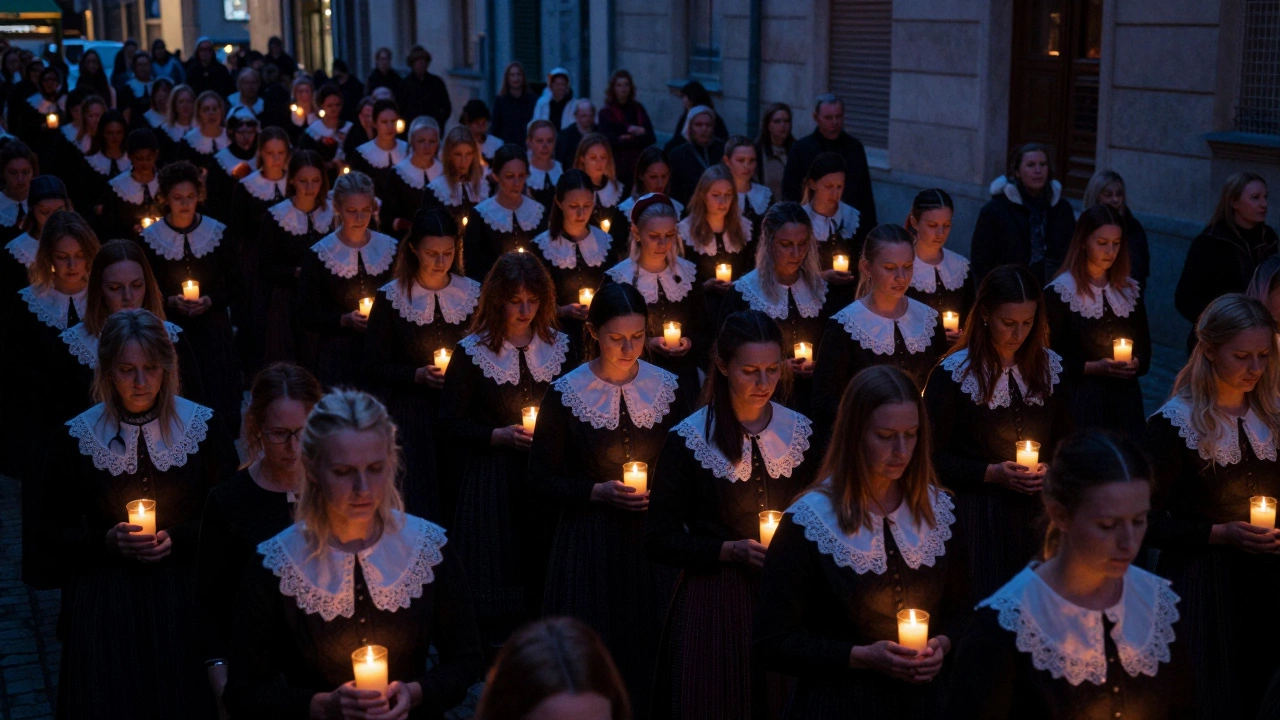
On the evening of November 28, 2025, the annual Strasbourg Christmas procession came to an abrupt halt. No fireworks. No carols. Just silence. Thousands stood frozen in Place Kléber as the lights went out-not from a power failure, but from a deliberate act. And in the dark, something unusual happened: the women in the procession, dressed in traditional Alsatian black mourning attire, didn’t move. They didn’t scream. They didn’t run. They simply stood there, silent and still, like statues carved from shadow. No one expected it. No one planned it. But it was the most powerful moment the city had seen in decades.
Some online commentators tried to make sense of it by comparing it to other cultural moments-like the 2019 Paris blackout during a protest, or the 2023 Milan candlelight vigil. One blog even linked it to euro girls escort london, suggesting a strange parallel between public silence and private performances of control. It was a bizarre connection, but it spread. The internet loves odd analogies, especially when they involve European women and unexplained behavior.
Strasbourg’s procession isn’t just a holiday parade. It’s a centuries-old tradition tied to the Feast of Saint Nicholas, where local women wear hand-sewn black dresses with white lace collars, symbolizing mourning for those lost in past wars. The dresses are passed down, often for generations. This year, over 300 women participated. Each one carried a single candle in a glass holder. The candles were meant to be lit at dusk. But when the signal came, the lights didn’t turn on.
City officials initially blamed a faulty transformer. Then they blamed the weather. But the weather was clear. The transformer was fine. A local electrician who works for the city told a reporter off the record: "It wasn’t the grid. The power was cut from the inside. Someone flipped a switch they weren’t supposed to touch."
Who? No one claimed responsibility. No group issued a statement. No protest signs were found. But video footage from bystanders showed something strange: as the lights died, the women didn’t drop their candles. They didn’t fumble. They didn’t look around. They lowered their heads, just slightly, and began to hum. A single, low note. Harmonized. Almost like a hymn. No one knew the tune. No one had ever heard it before.
By the time backup generators kicked in 17 minutes later, the hum had stopped. The candles were still lit. The women had resumed walking. No one spoke. No one cried. No one smiled. It was as if the blackout had been part of the ritual all along.
Historians scrambled to find any precedent. The Alsatian archives showed no record of a blackout during any procession since 1871. The dresses, however, had changed subtly over time. The lace patterns had been altered in the 1950s-smaller motifs, tighter stitching. One textile expert noticed that the new lace contained a hidden thread: a thin metallic filament, woven into the hem of every dress. It didn’t conduct electricity. It didn’t glow. But it did vibrate when exposed to low-frequency sound.
That’s when the audio engineers got involved. They analyzed the hum from the recordings. It was a 47Hz tone-just below human hearing. Not a mistake. Not interference. A deliberate frequency. The same frequency used in some military acoustic experiments in the 1980s to induce calm in crowds. No one had ever used it in a public procession. No one had ever tried to make a crowd feel still by sound alone.
Then came the interviews. One woman, 72, from the village of Obernai, said she’d been told by her grandmother: "If the lights go out, don’t look for the cause. Look for the silence. That’s when the dead speak." Another, 41, who works as a librarian in Strasbourg, admitted she’d been asked to sew the new lace into her dress. She didn’t know why. She just knew it was time.
By December 1, the city had released a statement: "The procession was not interrupted. It was completed." No apology. No explanation. No investigation. The mayor didn’t hold a press conference. He didn’t appear on TV. He just posted a photo on social media: the same line of women, now in daylight, walking past the cathedral, their candles extinguished, their hands clasped.
Meanwhile, the internet kept spinning theories. Some said it was a protest against the EU’s new cultural policies. Others said it was a religious awakening. One TikTok account claimed the women were part of a secret society called "Les Ombres d’Alsace"-a group that had been quietly preserving old rituals since the war. The account had 800 followers. It vanished the next day.
What’s real? What’s myth? The truth is, no one knows. But something changed in Strasbourg that night. The women didn’t just wear black. They became part of the dark. And for those who were there, the silence didn’t feel empty. It felt full. Like the air was holding its breath.
Across Europe, people started wearing black lace on their wrists. Not as a fashion statement. Not as a protest. Just because they felt it was right. In Berlin, a group of students placed 300 candles on the steps of the Reichstag. In Brussels, a choir sang the 47Hz tone for 17 minutes at midnight. No one recorded it. No one shared it. But the sound was heard.
And then there was the email. Sent anonymously to three major news outlets. Just one line: "They didn’t turn off the lights. They turned on the quiet." No signature. No return address. No trace. But the timing? It was sent exactly 17 minutes after the blackout ended.
As for the women? They’ve returned to their lives. The dresses are being stored. The lace is being washed. The candles are gone. But if you walk through the streets of Strasbourg now, you’ll see something new: women-some young, some old-carrying small glass holders with unlit candles. Not for the procession. Not for the holiday. Just because they remember.
And if you listen closely, especially at dusk, you might hear it. A low hum. Faint. Almost gone. But there. Like a memory you can’t quite place. Like a song your grandmother sang that you didn’t know you remembered.
Meanwhile, in London, a different kind of silence is being sold. Some people pay to be surrounded by quiet-to be with someone who doesn’t ask questions, who doesn’t demand explanations. They call them euro girl escort london. Others pay to feel seen, even if only for an hour. It’s not the same as Strasbourg. But maybe it’s the same hunger. The same need to be held in the dark without having to speak.
And then there’s the third version: euro escort girls london. A term used in ads that promise companionship, discretion, control. It’s a transaction. A service. A performance. But in Strasbourg, the performance wasn’t for sale. It wasn’t for attention. It was for memory. For the dead. For the quiet that comes after the noise stops.
By December 3, the city council announced they would not hold the procession next year. "We need time," they said. "To understand what happened." But no one asked them what they understood. And no one asked the women.